
A Gypsy’s Metamorphosis: From Passionate Rhythms to a Celestial Voice
Diego Ramón Jiménez Salazar, born in the winter of 1968 within the
narrow alleys of the Gypsy quarter of Embajadores in the heart of
Madrid, was the heir to a bloodline steeped in the melodies of
Southern Spanish Gypsy music, Flamenco. The nephew of the legendary
flamenco singer Rafael Farina, he was given the nickname "Cigala"
(meaning a type of Norway lobster) not by choice, but by the Losada
brothers, renowned flamenco guitarists. It was a metaphor for his
slender frame, his restless movement, and the boundless energy he
unleashed on the vibrant stages of Spain in his youth.
His professional path, from singing backing vocals for giants like the
legendary Camarón de la Isla (1) to
joining the global music powerhouse BMG, was a journey of discipline
and metamorphosis. Within a single year, he released two brilliant
albums, proving that he had reached a new maturity in Flamenco
(2). He was no longer merely
chasing the fiery rhythms and gritty vocals common in tradition;
instead, he sought a "celestial voice" and an absolute perfection that
defines the majesty of a performance through clarity and poise. To
sharpen his musical ear and transcend the oral traditions of Flamenco,
Cigala turned to the embrace of classical music and the noble whispers
of the clarinet (3) and oboe
(4), learning to listen more
selectively and break free from the cycles of repetition.
However, the spiritual turning point of his life occurred in a fated
union with Bebo Valdés, a wise elder whom Cigala first saw in the
documentary Calle 54 (5). Watching
Bebo’s hands work magic on the piano, Cigala wept uncontrollably,
wishing in the depths of his heart that he might possess such grace
and unpretentious serenity in his own old age. It did not take long
for that wish to manifest; Cigala soon found himself alongside Bebo,
learning, producing, and performing a new kind of music that bridged
the cultures of Spain and Cuba. These years of creation, spanning
concerts and albums, are never categorized by Cigala under the
simplistic and hollow label of "fusion." Instead, he views his work
with Bebo as the manifestation of a shared authenticity, arising
without premeditated artifice from the meeting of wandering souls and
the pure heartbeat of a moment of creation.
The Awakening of the Elder Pianist After Thirty Years of Silence
Bebo Valdés was born in 1918 in a small village on the outskirts of
Havana. He seemed chosen to be the beating memory and the architect of
the Golden Age of Cuban music (6).
Having befriended the piano keys at the age of twelve, he polished his
genius not only through native rhythms but also through a deep
understanding of Spanish classical masters like Manuel de Falla
(7) and Isaac Albéniz
(8). Bebo believed that Falla’s
music, with its precise arrangement and Spanish soul, spoke directly
to the heart. In the 1940s and 50s, as the director of the
world-famous Tropicana Club orchestra, he pioneered the daring
"Batanga" rhythm and collaborated with the titans of his era, such as
Benny Moré (9), pushing Cuban music
from traditional forms toward the improvisational frontiers of jazz.
However, the political upheavals following the Cuban Revolution forced
him into an unintended exile. In 1960, Bebo left his homeland for
Mexico, eventually anchoring himself in the cold of Stockholm, Sweden,
after meeting his wife, Rose Marie, during a European tour. For over
thirty years, he played in absolute anonymity in the piano bars of
Swedish hotels, far from the world's clamor, while the music industry
assumed that the brilliant star of Havana had been extinguished
forever.
His miraculous resurrection in his ninth decade of life came through
Fernando Trueba’s
(10) documentary Calle 54. The
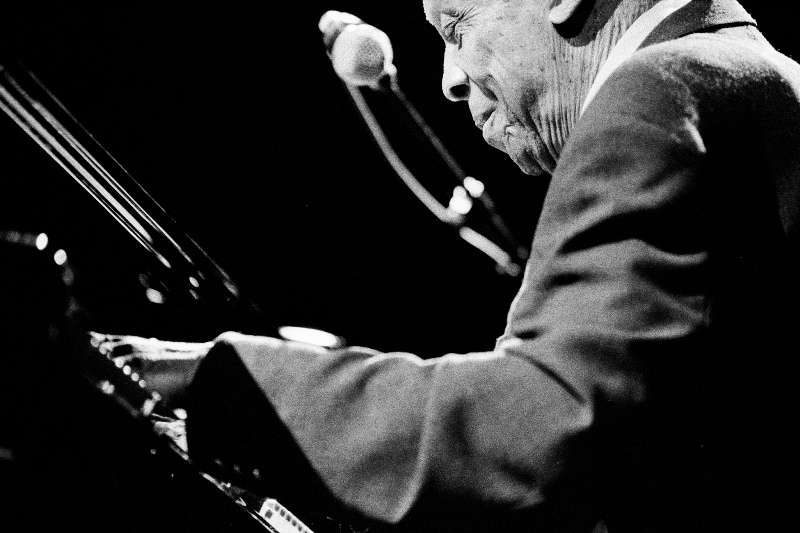
image of the old man with trembling but agile fingers playing
"Lágrimas Negras" (Black Tears)
(11) with such dignity suggested
that he had dissolved the entire pain of exile into the musical notes.
It was this very scene that shook Diego el Cigala’s heart in Madrid.
Enchanted by that authentic and familiar sound, Cigala sent a message
to Bebo through Trueba, sparking a bond where their fifty-year age gap
became meaningless. In their first meeting, Bebo found in Cigala’s
gravelly, soulful voice the echoes of shared roots that had traveled
from Spain to Cuba centuries ago. He discovered with amazement that
the Malagueña (12) cadence in
Flamenco perfectly matched the Guaguancó rhythm
(13) in Cuba. This intuitive
discovery led them to the studio to create Amar y Vivir (To Love and
to Live), a performance so moving that on that Sunday morning,
everyone in the studio wept. Bebo, who believed he learned immensely
from flamenco musicians, wore a medal gifted by a Gypsy brotherhood in
Almería (14) on his wrist. He
maintained that this collaboration was not a commercial "fusion," but
the return of two kindred souls to a shared home where the piano and
voice embrace and melt into a single dream.
The Creation of "Lágrimas Negras": Music That Was Not of This Earth
The recording of the album "Lágrimas Negras" at the Calle 54 studio in
Madrid was not a standard studio project, but a spiritual revelation
and an invocation of lost grandeur. Producer Javier Limón and director
Fernando Trueba witnessed the collision of two distant planets: the
84-year-old Bebo Valdés, with a mountain of experience and magical
hands that seemed to defy arthritis, and the 34-year-old Diego el
Cigala, whose eruption of emotion melted the music like volcanic lava.
Limón later recalled that the atmosphere in the studio was so heavy
with purity that many key tracks were captured in the first take.
Everyone knew that repeating such an elusive, intense, and almost
mystical state of heightened emotion, passion, and authenticity -
known in Spanish as Duende - was impossible. During the recording of
Amar y Vivir, a sacred silence enveloped the room; even the
technicians behind the glass wept, witnessing the moment the wounded
song of the Spanish Gypsies dissolved into the tropical melodies of
Cuba, transcending geographical borders.
This profound bond, where a weary old man coming back from exile and a
the passionate young Madrid gypsy made "longing" their common
language, immediately brought the world to its feet. The New York
Times, in a glowing review, named it the "Best Album of 2003," and
critics worldwide hailed it as a "miracle of world music." The
pinnacle of these honors came in 2004 when Lágrimas Negras won the
prestigious Latin Grammy Award and received multiple other
nominations.
Yet, beyond the Grammy statuettes, the true glory manifested in their
global tours, particularly on that historic night at New York’s
Carnegie Hall (15). To see Bebo
Valdés with a fatherly smile and Diego with the humility of a student
and tearful eyes embracing amidst the standing ovation of thousands of
mesmerized listeners was a vision of eternal reconciliation between
the two sides of the Atlantic. Selling over a million copies, the
album shattered all commercial clichés, proving that music rising from
the depths of the soul is a universal language that no border, time,
or tongue can imprison, a legacy that forever reminds us that true
beauty lies in the honest meeting of souls.
Footnotes
(1) Camarón de la Isla: Widely
considered the most influential flamenco singer of the modern era, he
revolutionized the genre by blending traditional roots with
contemporary sounds. His legendary partnership with guitarist Paco de
Lucía defined the "Nuevo Flamenco" movement.
go back
(2) Flamenco: A profound art form
from southern Spain that integrates singing (cante), guitar playing
(toque), and dance (baile). It is celebrated for its intense emotional
expression and its roots in Gypsy, Moorish, and Jewish cultures.
go back
(3) Clarinet: A versatile woodwind
instrument with a rich, mellow tone used extensively in both classical
orchestras and jazz ensembles. For Cigala, its fluid melodies served
as a tool for refining his musical ear beyond vocal traditions.
go back
(4) Oboe: A double-reed woodwind
instrument known for its haunting, penetrating, and expressive sound.
Its presence in classical music provided Cigala with a structured,
academic counterpoint to the raw spontaneity of flamenco.
go back
(5) Calle 54: A critically
acclaimed 2000 documentary by Fernando Trueba that captures live
performances of the masters of Latin Jazz. The film is credited with
introducing Bebo Valdés to a new generation and sparking the interest
of El Cigala. go back
(6) Golden Age of Cuban Music: A
period spanning the 1940s and 50s when Havana was a global cultural
hub, birthing iconic rhythms like Mambo, Chachachá, and Son. It was an
era of grand orchestras and legendary performers at venues like the
Tropicana. go back
(7) Manuel de Falla: Spain's most
distinguished composer of the early 20th century, famous for
integrating Spanish folk music into classical forms. His works, such
as The Night in the Gardens of Spain, deeply influenced Bebo Valdés's
approach to harmony. go back
(8) Isaac Albéniz: A celebrated
Spanish pianist and composer best known for his piano suite Iberia,
which captures the spirit of different Spanish regions. His fusion of
romantic piano music with nationalistic themes was a cornerstone of
Bebo’s musical education. go back
(9) Benny Moré: Known as "El
Bárbaro del Ritmo," he was a master of many Cuban genres and possessed
a unique, self-taught genius for bandleading. He remains one of the
most beloved figures in Cuban music history and a contemporary of Bebo
Valdés. go back
(10) Fernando Trueba: An Academy
Award-winning Spanish filmmaker and producer with a deep passion for
Latin Jazz. He was the visionary behind the Calle 54 project and the
catalyst who brought Bebo Valdés and El Cigala together.
go back
(11) Lágrimas Negras (Black
Tears): Originally a 1929 bolero-son by Miguel Matamoros, it became
the title track of the legendary album by Bebo and Cigala. It serves
as the ultimate symbol of the fusion between Cuban heartache and
flamenco passion. go back
(12) Malagueña: A traditional
flamenco style (palo) originating from Málaga, characterized by its
melodic richness and lack of a fixed rhythmic beat. Its harmonic
structure shares surprising similarities with certain Afro-Cuban
rhythms. go back
(13) Guaguancó: A subgenre of
Cuban Rumba that features complex percussion patterns and
African-inspired call-and-response vocals. It represents the rhythmic
soul of Havana’s street music and served as a bridge in Bebo and
Cigala’s collaboration. go back
(14) Almería: A city in
southeastern Spain with a deep-rooted Gypsy culture and a long history
of flamenco tradition. The medal Cigala gave to Bebo was a symbolic
token of brotherhood from the flamenco community of this region.
go back
(15) Carnegie Hall: A
world-renowned concert venue in New York City, famous for its prestige
and extraordinary acoustics. Bebo and Cigala’s performance here marked
the global triumph of their collaboration and a historic moment for
Latin music. go back